
Help to Make a Data Collection Tool for a Dissertation

To achieve credible and accurate findings, it is essential to use the appropriate tools and software to collect and analyze data. However, creating data collection tools is challenging for some students due to the instruments’ technical and methodological requirements. At My Dissertation Writing Services, we help to make a data collection tool for a dissertation that aligns precisely with the research design, objectives, and academic needs of our clients.
Our seasoned professionals have expertise in designing tailor-made questionnaires, interview protocols, and observation guides of the utmost academic and ethical quality. In this article, we have highlighted our data collection tool-making services, including questionnaire and interview protocol development, as well as data collection tools for both quantitative and qualitative dissertations. We have also provided tips for creating practical data collection tools.
Our Data Collection Tool-Making Services
1. Questionnaire Making Services for Quantitative Research
We have specialists who help students create structured questionnaires that yield quantifiable and objective responses. Our professionals assist scholars in crafting precise questions, selecting the appropriate scaling methods, and guiding clients on how to conduct pilot tests to maintain consistency. We customize client questionnaires to meet their dissertation objectives and generate statistically sound data for quantitative dissertations.
2. Interview Protocol Making Services for Qualitative Research
Our experts structure interview procedures in a manner that encourages participants to share their thoughts and perspectives freely. We ensure that the questions have a logical flow and adhere to the ethical standards during interviews. Interview protocols are crucial for gathering high-quality, insightful qualitative data, which significantly enhances the dissertation’s results.
3. Mixed-Methods Data Collection Assistance
Our team provides integrated and thorough data collection assistance that perfectly aligns with both quantitative and qualitative methods. With our approach, we strike a balance between counting and describing, adding context and depth to various types of data. Our approach enhances the validity, reliability, and value of the research results in the long run. In case you are a PhD student in need of dissertation writing help, whether it is the introduction, literature review, data analysis and discussion sections, or even the whole manuscript, contact us today to get expert help from our experienced writers.
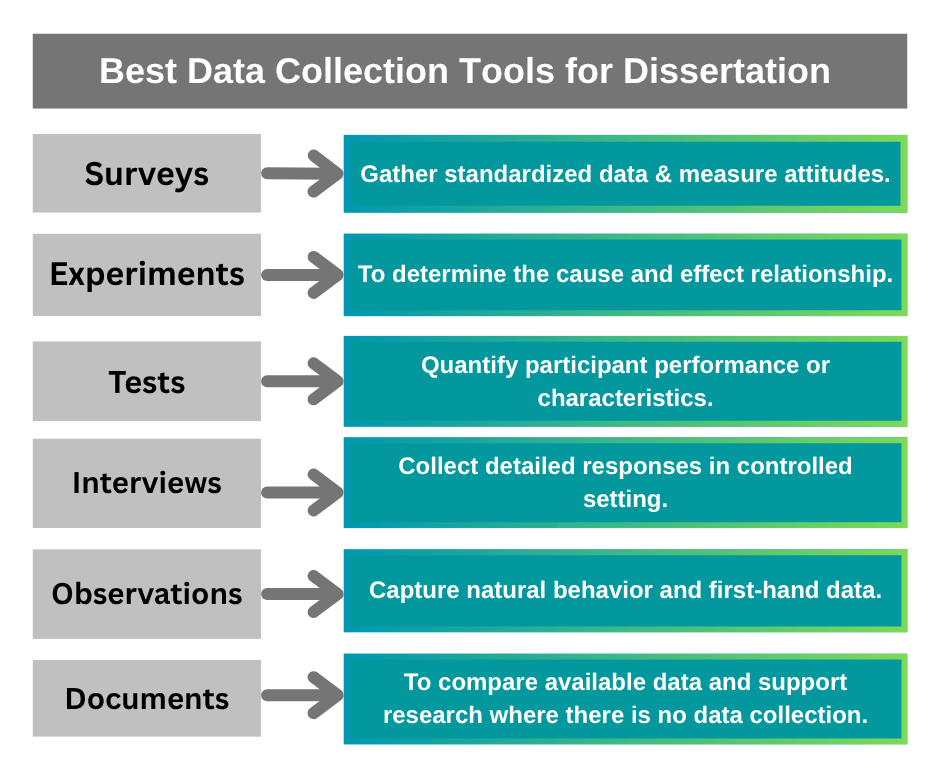
Data Collection Tool for Quantitative Dissertation
1. Surveys and Questionnaires
Quantitative research typically involves the use of surveys and questionnaires to collect data. Surveys and questionnaires enable researchers to collect data on a significant number of participants with much efficiency. We help clients create unbiased survey questions and measurement scales to use, including the Likert and semantic differential scales. Our experts ensure that clients’ questionnaires yield valid and reliable results that align with the research hypothesis.
2. Structured Observation Checklists
Structured observation checklists are suitable for studies that require analysis of human behavior or the environment. Researchers use structured checklists to record specific actions, reactions, or events that occur during an observation. Our experts assist clients in developing observation categories and rating scales that are easy to interpret.
3. Tests and Measurements
Scholars use standardized tests or researcher-constructed measures to assess knowledge, performance, attitudes, or psychological characteristics such as motivation, personality traits, or cognitive abilities. We help scholars choose and create valid tests that accurately measure variables of interest. Our specialists also assist clients with designing pilot testing plans and statistical reliability analysis to ensure that the tools meet academic standards and requirements.
4. Experimental Tools and Instruments
Researchers use experimental tools and instruments to gather objective data in controlled conditions by the use of different devices, including biofeedback equipment, questionnaires, and reaction time software. To ensure the experimental tools are reliable, we conduct the appropriate calibration for accurate research findings. Our team helps scholars choose accurate experimental instruments for high-quality and credible data collection.
Data Collection Tool for Qualitative Dissertation
1. Interviews
Interviews are the most common method for collecting qualitative data. Interviews can be structured, semi-structured, or unstructured, depending on the level of flexibility required. We assist researchers in developing interview guides with open-ended questions that encourage deeper, more thoughtful responses. Our team ensures that the interview questions align with the client’s research goals and are both unbiased and ethically sound.
2. Focus Groups
Researchers use focus groups to collect information from participants through guided discussions. We assist our clients in establishing focus group protocols, including participant selection, question sequencing, and moderation guidelines. The method helps our clients to gather shared opinions and address issues that arise in group interactions.
3. Observation Guides
One of the most effective methods for analyzing social interaction and natural behavior is direct observation. Our team helps develop observation guides that define what to see, when to look, and how to record the data in a systematic and organized manner. Regardless of whether it is a participant or non-participant observation, we ensure that the tool collects data regularly and ethically.
4. Document Analysis
Document analysis is a research method used to examine existing documents, such as reports, letters, diaries, or policy papers, in order to understand their content and context. Document analysis helps comprehend written communication patterns, meanings, and trends. We assist students in designing a coding system and an analysis plan to examine documents suitably.
Tips to Create Effective Data Collection Tools
1. Conform to Research Objectives
Each question or observation item should be specifically relevant to the scholar’s research purposes and hypotheses. Scholars use data collection instruments to record the data required to address the research questions. By ensuring that each tool conforms to the study objectives, researchers make the data analysis process more focused and meaningful, producing accurate and reliable findings.
2. Ensure clarity
It is essential to use clear, concise, and straightforward language to prevent confusion among respondents. Complicated or vague wording can lead to misunderstandings among the readers because it creates ambiguity. A clear and readable tool helps ensure consistent responses and overall data quality.
3. Avoid Bias
Scholars must frame the questions objectively to avoid biasing the respondents. Avoid using biased, loaded, or emotionally charged language that could skew the results. Providing balanced response options ensures fairness and helps gather valid, unbiased data.
Examples of biased and unbiased questions:
Biased: Don’t you feel that telehealth has significantly improved patient outcomes?
Unbiased: What is your opinion on telehealth’s effectiveness in improving patient outcomes?
4. Pilot Test the Tool
Test the tool with a small group of potential respondents to identify any clarity, timing, or structural issues that may impact data quality. Pilot testing a tool enables scholars to enhance their instrument, making it more reliable and easier to use. For those in need of a data collection tool for a dissertation, we offer reliable services, ensuring that the instruments align with the research objectives and can produce valid and dependable results.
5. Uphold Ethical Standards
Always get informed consent from participants before starting data collection. Protect participant privacy by keeping responses confidential and removing identifiable information. Following ethical practices protects participants and builds trust in the dissertation study.
6. Use Proper Scaling
One should use measurement scales that align with the data type and the research purposes. Using the wrong scale might limit the performance of proper statistical or thematic analysis. Proper scaling optimizes both the interpretability and the accuracy of the resultant findings, the latter reflecting the participant’s response.
7. Buy Expert Review
Having professionals review one’s data collection tool helps identify errors and improve validity. Our professionals provide pertinent insights regarding the questions ‘ validity, form, and alignment with research objectives. As the final step in the writing process, expert review
Why Get Our Help to Make a Data Collection Tool for a Dissertation?
Timely Delivery of Tasks
Developing a data collection tool that is valid is time-consuming. At our company, we develop effective tools that meet the requirements the first time or with minimal revisions. Additionally, we ensure the timely delivery of tasks, even on short deadlines, without compromising on quality.
24/7 Availability
Our customer service agents are available 24/7 to ensure we respond to clients’ inquiries on time. One can reach out by emailing, contacting us, or joining our live chat to talk to our friendly customer support agents. We ensure our clients get updates on the progress of their orders anytime they need them.
Expertise Across Research Methods
Our experienced professionals make methodologically sound data collection instruments that align with clients’ research designs, regardless of whether the studies involve observational checklists, surveys, experiments, or interviews. We help scholars change complex theoretical concepts into valid, clear, and practical measurement tools. Also, we help our clients choose the most appropriate data collection method based on the research objectives, variables, and design.
Customized Tool Designs
Whether your dissertation is quantitative, qualitative, or mixed methods, we customize each data collection tool to suit the design and objectives of the dissertation. From structured questionnaires to interview guides and focus group schedules, we adapt each tool to your methodology. Reach out to our professionals today to help you with your unique research, ensuring your data collection process is rigorous, ethical, and aligned with your study goals.
Summary
Creating a data collection instrument is one of the most crucial tasks in any dissertation, as it will significantly impact the credibility and quality of the research findings. By learning about the various tools and best practices, one can enhance the validity, accuracy, and depth of the research. If a student is unable to craft a valid and reliable research instrument, our experts are always ready to assist. Reach out to us now for professional help to make a data collection tool for a dissertation tailored to your topic, research design, and academic specifications. Talk to our professional customer support agents for any inquiries or to place an order for a data collection tool for a dissertation.