
Professional Help with Secondary Data Analysis for a Dissertation
What is Secondary Data Analysis?
Secondary data analysis is the practice of utilizing data that other investigators have collected for different purposes to answer new research questions. The advantages of conducting a secondary data analysis for the dissertation include economic savings, generating new hypotheses or clarifying research questions, and avoiding overburdening sensitive populations. While secondary data analysis enables researchers to conduct data analysis, it also has its disadvantages, some of which include a lack of familiarity and the complexity of data.
Secondary data analysis is an approach mostly utilized in social and behavioral sciences where ethical or logistical constraints may limit the ability to collect and analyze primary data. By conducting secondary data analysis, scholars can optimize the value of existing datasets to identify patterns and trends in data, saving on the time needed to collect primary data. Are you a PhD student looking for help with secondary data analysis for a dissertation? Look no more as we assist scholars with organizing and analyzing existing datasets using advanced tools and techniques to help them answer their research questions, test hypotheses, investigate sensitive populations, and make meaningful conclusions. In this article, we have discussed the procedure we follow when analyzing secondary data for a dissertation. We have also highlighted why scholars should utilize secondary data analysis for the dissertation.
Why Use Secondary Data Analysis for Your Dissertation?
- Secondary datasets are less costly and take a shorter time to organize for analysis relative to primary datasets.
- Secondary datasets cover a broad range of topics and are collected by members from reputable organizations, so the quality is usually high.
- For large secondary datasets, scholars can take advantage of the advanced statistical techniques employed, such as hierarchical linear modeling, which may not be easy to apply in a primary data analysis.
- Secondary data analysis supports research on sensitive populations or research areas.
- Secondary data analysis is useful when primary data is not feasible.
In case you are looking for professional secondary data analysis services, our experts help scholars with their dissertations by analyzing existing data to answer new research questions or re-evaluate previous findings.
How Our Experts Analyze Secondary Data for a Dissertation
Step 1: Determine the Research Question
Developing clear and focused research questions is a crucial step because the inquiries determine the design, methodology, and analysis of the entire study. Our professionals identify an area of interest and narrow the focus of the study to develop a strong question that is researchable using secondary sources, feasible, specific, relevant, and complex enough to develop an answer for the study. By hiring our experts, clients get well-crafted research questions that define the scope of the study, align with methodological approaches, and contribute to the advancement of the existing body of knowledge.
Step 2: Locate and Collect Secondary Data
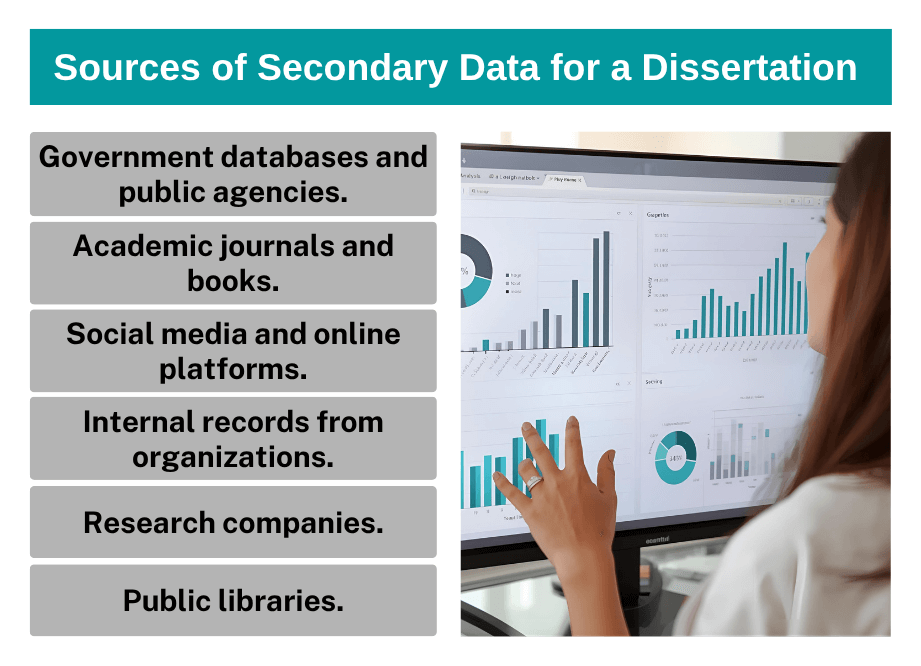
Secondary data is that which has been previously collected and is under consideration to be reused for new research questions, for which it was not originally intended. Our experts locate high-quality secondary data sources, including government databases from trustworthy agencies, academic journals, private entities and international projects, and publicly available datasets. Once we have identified appropriate sources, our experts collect the necessary data using techniques such as web scraping, downloading data sets, or database retrieval.
Step 3: Evaluate the Relevance of the Data
Evaluating secondary data before conducting analysis is essential to determine its quality and applicability to the research question. When evaluating the relevance, our experts consider key factors such as the data’s original purpose, collection protocols, form, date gathered, population involved, sampling strategy, and questions asked. Getting expert help with secondary data analysis for a dissertation prevents scholars from wasting time on outdated data that does not align with research goals and ensures a meaningful analysis with valid conclusions.
Step 4: Assess the Credibility of the Data
Utilizing credible data for the dissertation helps in establishing a strong foundation for the research and ensures that the information presented is accurate and trustworthy. The criteria our experts consider when evaluating the credibility of secondary data include the credentials of original researchers, consistency of the data with that from other sources, and whether the data has been used in other credible published studies, among others. Our highly skilled team helps clients collect their data from trusted sources, thereby ensuring that it is accurate and expert-reviewed for dissertations.
Step 5: Conduct Data Analysis
Secondary data analysis involves applying tools and techniques to analyze existing data to answer research questions, validate hypotheses, and derive useful insights. Our professionals offer customized solutions based on the client’s research objectives, including quantitative, qualitative, and mixed methods analysis of secondary data. When offering secondary statistical analysis services for a dissertation, we conduct descriptive analysis by numerically or graphically summarizing data to offer an overview of the main characteristics of the dataset and inferential statistics to make conclusions about a population based on a sample. Struggling with dissertation statistics? Hire a statistician for secondary data analysis for accurate results custom to your unique academic needs.
For qualitative secondary data analysis, we utilize pre-existing non-numerical data, such as semistructured interviews, responses to open-ended inquiries in questionnaires, and field notes that are derived from previous research studies. Our experts utilize their skills and advanced software to conduct various types of qualitative analysis, including grounded theory, thematic, content, narrative, and discourse analysis. We customize our secondary qualitative data analysis services for the dissertation based on the client’s needs.
Step 6: Interpretation and Reporting
Interpretation is the practice of examining the output from the secondary data analysis and identifying patterns, trends, and relationships in data. When interpreting the results of the secondary data analysis, we evaluate the findings in the context of the research question, highlighting any limitations and biases and how they may affect the conclusions made. Our experts also offer data analysis report writing services to help clients evaluate results and apply the findings in recommending areas of future research. In the data analysis report, we include the summary of the study, background information, type of secondary data collected, analysis techniques utilized, and the key findings.
Get Expert Help with Secondary Data Analysis for a Dissertation From Us
The aim of conducting a secondary data analysis is to use existing datasets to answer research questions, evaluate relationships, or generate insights without collecting primary data. To effectively conduct an accurate secondary data analysis for a dissertation, scholars require skills and extensive knowledge in data analysis to acquire meaningful results. We have the best team of experts who have the proficiency and expertise to collect, clean, analyze, visualize, and report findings from secondary data.
Our experts have extensive skills in analyzing and interpreting data using software packages such as SPSS, Python, R, STATA, SAS, Minitab, Tableau, Excel, MATLAB, NVivo, and MAXQDA. We aim to support PhD scholars in maximizing the potential of existing datasets by transforming secondary data into useful insights, thereby contributing to their academic success. Looking for reliable secondary data analysis help for the dissertation? Get in touch with us by hitting the contact us button for any inquiries, and you will receive a response promptly.

Key Reasons We Stand Out as the Best Secondary Data Analysis Services for a Dissertation
Team of Professional Statisticians and Data Analysts
Our secondary data analysis services are offered by PhD-level subject-matter experts who have skills and knowledge in analyzing data using various software.
Excellent Customer Support
From initial consultation to order submission, our dedicated team of writers and data analysts provides comprehensive support at every step of the secondary data analysis process, empowering clients with the expertise required to achieve successful research outcomes.
Fast Turnaround Time
Our efficient workflows enable us to promptly conduct the secondary data analysis process and ensure timely delivery, thereby allowing scholars to focus on other aspects of their dissertation research without unnecessary delays.
24/7 Assistance for Secondary Data Analysis
Our dedicated statisticians and data analysts are available round the clock to offer real-time assistance with analyzing existing data, responding to inquiries, and offering revisions based on client or committee member feedback.
Summary
Secondary data analysis involves utilizing existing data sources to answer new research questions or re-evaluate previous study findings. Students struggling with analyzing data or balancing other commitments with conducting their study can opt to buy data analysis services for a dissertation from experts for high-quality results tailored to their unique academic needs. Maximize the value of existing data sets for your dissertation with our professional secondary data analysis services. Contact us or join our live chat to talk to our friendly customer support agents who are available 24/7 to respond to your inquiries promptly.