
Get Help with Primary Data Analysis for a Dissertation from Professionals

When developing a dissertation, researchers can get data from either primary or secondary sources. Secondary sources include information obtained from scholarly sources, government websites, databases, and reports, among others. Primary sources are original data collected through methods such as surveys, interviews, experiments, and observations. Although primary data offers originality and credibility to research, converting raw data into meaningful conclusions may be challenging for some scholars, leading them to seek assistance from experts. At Mydissertationwritingservices, we provide help with primary data analysis for a dissertation at all research stages. This article contains a discussion on our data analysis services, the advantages of using primary data in a dissertation, how to collect primary data, and when to hire a statistician for primary data analysis.
What is Primary Data Analysis?
Primary data analysis involves examining and interpreting original data collected firsthand by the researcher to address the research questions and test hypotheses. Depending on the nature of the study, primary data may be in the form of surveys, interviews, focus groups, experiments, or observations. When developing dissertations, primary data analysis forms the direct relationship between theory and reality. Primary data analysis is the pillar of empirical research and is used to ensure that the work is original, reliable, and contributes to the development of academic knowledge.

Why Use Primary Data for Your Dissertation?
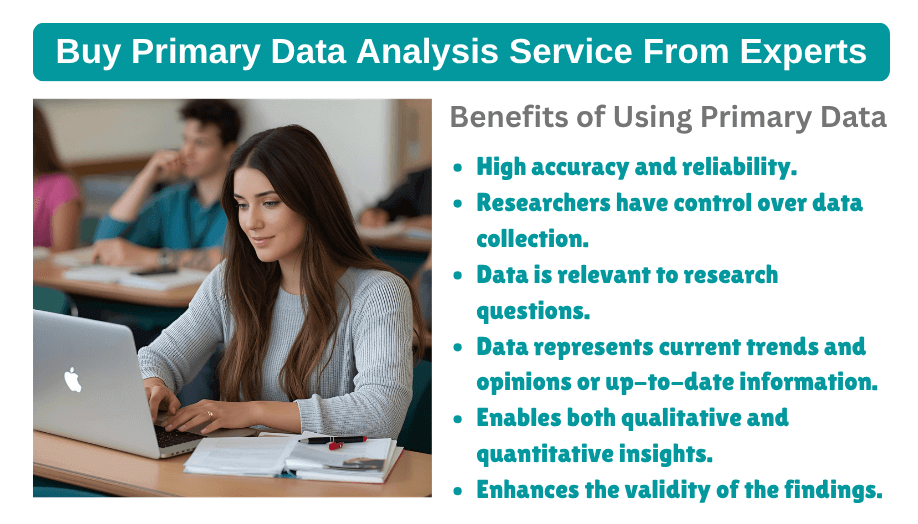
We assist researchers in transforming raw primary data into valuable insights, ensuring that every analysis upholds academic rigor, methodological soundness, and makes a meaningful contribution to the field. The following are the benefits of using primary data when conducting dissertation research:
- Increases the originality and credibility of the dissertation results.
- The researcher has control over the quality of data.
- One can collect data only related to the research questions.
- Enhances credibility and academic rigor.
- Enables scholars to explore specific variables.
- Provides up-to-date data that reflects the current situations or trends.
Overview of Our Primary Data Analysis Services
1. Preparation and Cleaning of Data
Data preparation and cleaning involve identifying missing values, outliers, removing duplicates, incomplete responses, and verifying the accuracy of the data. Our experts ensure proper preparation and data cleaning, leading to the production of reliable results without errors that may compromise the validity of the client’s research. Through comprehensive data cleaning, we ensure that the results are reliable and valid and can support meaningful conclusions.
2. Quantitative Data Analysis
In the context of quantitative analysis, we review primary data gathered through surveys, experiments, or other studies that are based on measurements. Some of the methods our professionals use when helping students to determine patterns and relationships include descriptive and inferential statistics. Examples of descriptive statistics offered by our analysts include frequency distributions, standard deviation, mean, median, and mode. Inferential statistics examples include regression analysis, t-tests, ANOVA, and chi-square tests. Our professionals use software such as SPSS, R, Python, Excel, and STATA to help researchers perform complex computations effectively and yield the correct results that are ideal when writing dissertations.
3. Qualitative Data Analysis
Primary qualitative data is collected through methods such as interviews, open-ended questionnaires, or focus groups. When offering qualitative data analysis, our experts follow these steps: transcribing, organizing textual data, coding responses, categorizing codes, developing main themes, identifying patterns, and interpreting the views held by the respondents. Our experts have the required skills to conduct qualitative data analysis using software such as NVivo and MAXQDA to support thematic, narrative, and content analysis to get insights into human behavior, perceptions, and experiences.
4. Mixed-Methods Data Analysis
When writing mixed methods dissertations, we blend both quantitative and qualitative primary data collection methods to provide a comprehensive understanding of the research question. In mixed-methods analysis, quantitative primary data is typically used to measure relationships, trends, and patterns. On the contrary, qualitative data adds depth by explaining the meaning behind patterns and trends. To strengthen the reliability and validity of the findings, our experts apply techniques such as triangulation and merging data sets. In case you need help with mixed methods primary data analysis for your dissertation, place an order now or contact us to make an inquiry today.
5. Result Interpretation and Reporting
We understand that it is essential to accurately interpret the results and transform the findings into meaningful insights that help address the research objectives. When interpreting the results, we explain what the findings reveal about the hypotheses of the research questions. Also, we relate the findings to the previous literature and how the results contradict the expectations. Additionally, we write the limitations of conducting primary data analysis and the recommendations for policy and future based on the findings.
We prepare an analysis report by crafting a clear and structured results chapter that follows APA or the recommended institutional formatting guidelines. Effective reporting also includes presenting data visually through tables, graphs, and charts, and organizing results logically to enhance clarity and comprehension.
Methods for Collecting Primary Data
Choosing the correct method hinges on the research question, objectives, and target audience. Each primary data collection method necessitates proper planning to ensure validity, data integrity, and adherence to ethical standards. The following are some techniques of collecting primary data, depending on the dissertation topic and design:
- Surveys and questionnaires: Excellent options when involving larger groups of people and for quantitative research.
- Experiments: Test hypotheses by controlling variables in experimental settings, used in quantitative research.
- Observations: Model natural behaviors and interactions within real-life situations, for collecting both qualitative and quantitative data.
- Interviews: Provide qualitative data on individual experiences, attitudes, and beliefs.
- Focus Groups: Gather a variety of opinions and explore group dynamics surrounding a specific topic for qualitative research.
When to Hire a Statistician for Primary Data Analysis
Advanced degree scholars may need to hire a statistician for data analysis in cases of complex methodologies, large data sets or where expert statistical techniques are required. Additionally, many students struggle to find enough time for data analysis as they juggle work, family, and academic responsibilities. This makes most PhD scholars seek professional support with dissertation data analysis and write-up so they can save time and focus on other essential tasks.
One can also hire a statistician for help to design data collection instruments, determine appropriate sample sizes, and select the right statistical tests. Also, for scholars who lack confidence and the skills needed to operate a specific statistical software may hire an expert to help them analyze data.
Once our clients engage us for primary data analysis services, our experts analyze the data correctly, strengthening the credibility and impact of the research findings.
Why Seek Help with Primary Data Analysis for a Dissertation
1. Expertise and Accuracy
Our professional analysts possess extensive expertise in both statistical and qualitative analysis. We ensure that findings and the conclusions are valid, significantly reducing the likelihood of analytical or interpretive mistakes that can occur during self-analysis. Our experts help students select the proper analytical techniques, verify data integrity, and produce results that meet the highest academic and methodological standards.
2. Time Efficiency
Data analysis can be a significant time drain, particularly in cases involving large datasets or complex models. By getting help with data analysis for a dissertation from our experts, students can focus on other social activities or other academic tasks, while our specialists undertake the technical analysis. Our data analysts make it easy to navigate all stages of the process, from data cleaning to interpreting the results.
3. Statistical Software Proficiency
For primary data, specialized programs such as SPSS, R, NVivo, or STATA are required. Our professional analysts are familiar with these tools, and therefore, statistical tests and data visualization techniques are applied accurately. We harness the power of advanced software to conduct precise analyses, create explicit graphical representations, and make sure all outputs meet dissertation standards.
4. Privacy and Confidentiality
Our team prioritizes client confidentiality, and we protect all research and personally identifiable information shared during the data analysis process. We also have a strong privacy policy that prohibits us from sharing client information with a third party. We have built trust over the years with the many successful clients we have helped and the many referrals we have received from them.
Buy Primary Data Analysis Services for a Dissertation from Our Experts
Through the involvement of our professionals, a comprehensive method of analysis is bound to be achieved, where all findings are in tandem with the purpose of the research and contribute to meaningful academic literature insights. Every project is tailored according to the research design, discipline, and needs of the methodology. Our primary data analysis services include a spectrum of core activities, such as:
- Data cleaning and coding
- Thematic or statistical analysis
- Interpreting findings
- Tables, figures, and summaries preparation
- Assistance with the writing of the methodology and results chapters
Summary
A sound empirical dissertation study is anchored on primary data analysis. Through the collection and analysis of original data, researchers gain control over their methodology, make their work unique, and generate valid and reliable results. We provide professional primary data analysis services, ensuring clearly presented results and accurate interpretation of the findings. In case you need personalized, professional help for dissertation data analysis, contact us, as we will help transform your raw data into meaningful insights that help test hypotheses, address research questions, or even advance the body of knowledge.