
Professional Dissertation Methodology Writing Help With Example

The methodology chapter contains a description of the research design, data collection techniques, and justifies the methodological choices made throughout the study. However, some students find it challenging to convey this aspect of their work with the depth, clarity, and precision it requires. Could you be a PhD scholar looking for dissertation writing services? Our professional team provides expert dissertation methodology writing help, enabling students to develop methodology chapters that are clear, evidence-based, and in alignment with the institution’s guidelines. This article contains an explanation of what a dissertation methods chapter is, the processes involved in writing it, the major types, the challenges that arise when writing the methodology chapter, and tips on how to identify the most suitable professional assistance provider.
What Is a Dissertation Methods Chapter?
A dissertation methods chapter describes the processes, approaches, and rationale used to execute a study. The methodology chapter provides a detailed account of the data collected, analyzed, and interpreted in response to a specific research question/s or hypotheses being tested. The dissertation methods chapter is a cornerstone of research, providing both clarity and credibility while allowing readers to assess the reliability and validity of the findings.
The methodology chapter bridges the gap between the theoretical underpinnings and the practical findings of the study. The dissertation methodology chapter provides proof that the research process is reproducible and that the results originate from systematic, ethical, and academically sound procedures. A clearly defined methodology reflects the study’s logical consistency and demonstrates methodological rigor, as well as congruence with the study’s objectives.
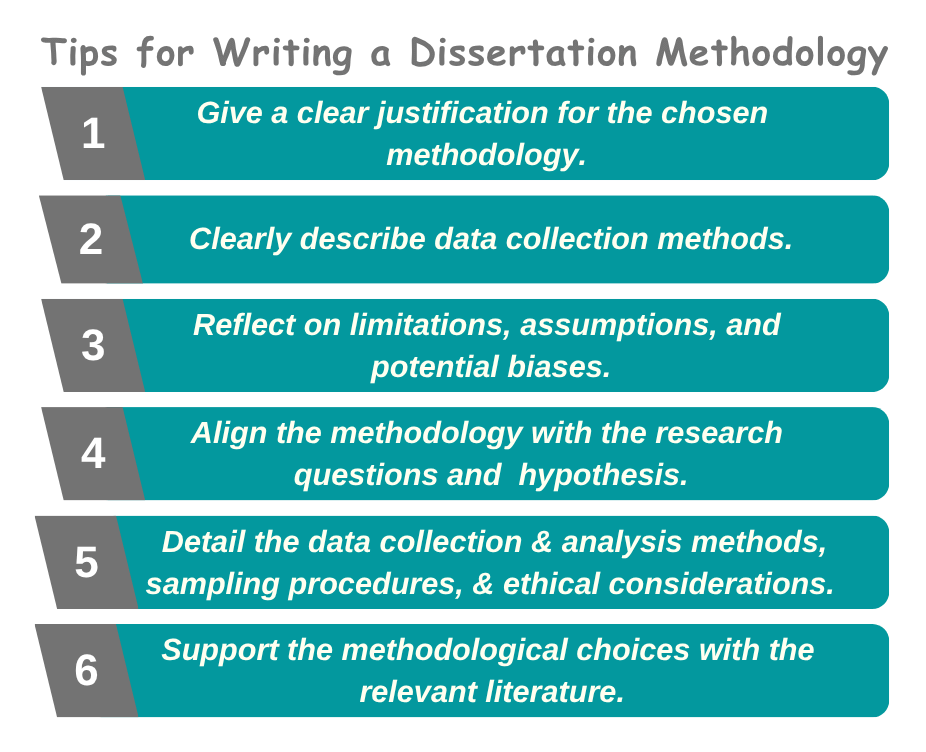
How to Write Methodology for a Dissertation
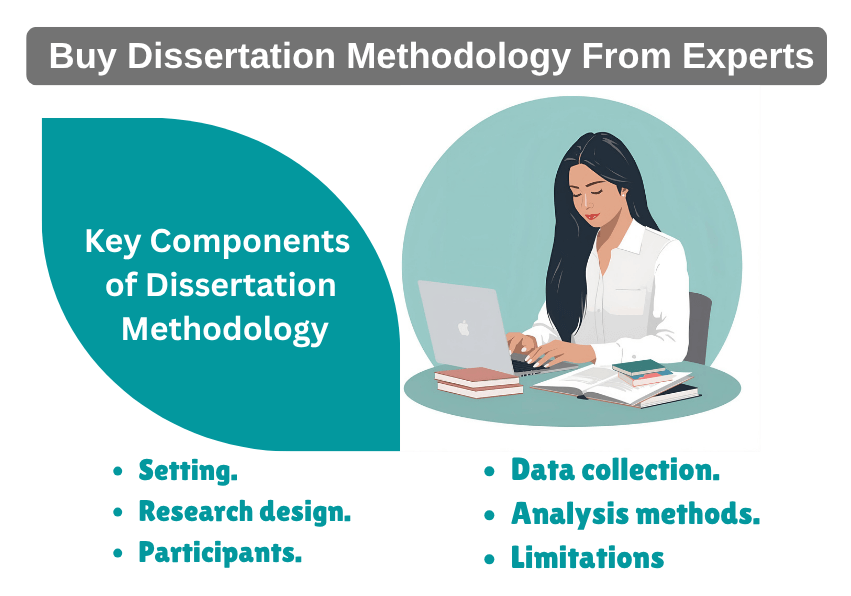
A well-organized methodology chapter typically consists of several core components. Each part must demonstrate interconnection and justify the choice of research method. The main parts of a methodology chapter are as follows.
1. Research Design
The research design is the comprehensive plan and strategy that clearly and logically connects all the components of a study. The study design outlines how the research problem will be solved and the procedures for data collection and analysis. Depending on the nature of the research questions, a dissertation can be based on a quantitative, qualitative, or mixed-methods design. We support researchers in formulating research designs that align with their study objectives and the type of data.
2. Population and Sampling
The population refers to the entire group of respondents relevant to the research aims, whereas the sample is the subset chosen for participation or analysis. Proper sampling guarantees the credibility, generalizability, and neutrality of the findings. This section typically contains a description of the population of interest, the sampling frame and method, the sample size, and the criteria for inclusion and exclusion of the participants.
3. Data Collection Methods and Tools
Various techniques and instruments for collecting data to achieve the research objectives are described in this section. Properly selecting data collection instruments is a crucial step in ensuring the process yields valid and reliable results. Commonly used instruments include surveys and questionnaires for collecting quantitative data, interviews and focus groups for gathering qualitative data, and various observation techniques in behavioral or ethnographic research.
4. Data Analysis Procedures
The data analysis procedures section explains how the raw data were transformed into meaningful results. Quantitative analysis may include descriptive statistics, such as means, frequencies, and standard deviations and inferential statistics, including correlations, regressions, t-tests, or ANOVA. Quantitative data analysis software include Statistical Package for the Social Sciences (SPSS), R, Stata, Excel, Python, among others, for accuracy and consistency control.
For qualitative studies, the analysis may consist of thematic or content analysis of the texts to identify patterns and meanings. Data analysis may involve coding transcripts or texts using software such as NVivo, MAXQDA, and ATLAS. ti, among others. Also, the analysis may involve the interpretation of the data through frameworks such as grounded theory or phenomenology.
In mixed-methods, the two research designs are combined, with special attention to how the quantitative results and qualitative interpretations enhance one another. Our team helps clients with both qualitative and quantitative dissertation data analysis procedures at affordable rates. We ensure each data analysis step is transparent and reproducible to attain clarity and consistency.
5. Reliability and Validity
Reliability and validity are the main signs of methodological rigor. The reliability and validity section enables the researcher to demonstrate that the research methods produce reliable and credible findings. In qualitative research, this section is known as trustworthiness. Reliability refers to the use of consistent and stable instruments and procedures, while validity indicates the extent to which these instruments and methods accurately capture the intended constructs. The potential threats to reliability and validity, such as bias, measurement error, or sampling restrictions, must be addressed, which in turn enhances the overall quality of the methodology chapter.
6. Ethical Considerations
The ethical considerations section must present the principles and protections that were in place during the study. Key elements include informed consent obtained from participants before the data collection process starts, confidentiality, and anonymity to secure the identities of the respondents. Other considerations include the application of data protection measures that consist of secure storage and limited access, minimization of harm and respect for the rights of the participants, and getting ethical approval from the review boards or relevant institutions. In addition to the above sections, one ought to include the limitations and potential biases in the methodology chapter.
Types of Dissertation Methodology
1. Quantitative Methodology
The quantitative approach is designed to ensure accuracy, broad applicability, and verification through the use of statistical methods. The quantitative methodology captures patterns and enables generalization of findings, although sometimes at the expense of contextual and subjective aspects. Quantitative methods utilize structured data collection tools, such as surveys and experiments, along with mathematical and statistical analysis, and hypothesis testing. Quantitative methodology primarily focuses on assessing the relationships among the variables, which are the defining components of this approach.
2. Qualitative Methodology
With qualitative methodology, a researcher articulates a particular phenomenon through descriptions of, and accounts for, subjective variables such as experiences, actions, and attitudes. Understanding the meaning rather than the measurement constitutes the main objective of qualitative methodology. Qualitative inquiry is contextual and uncovers that which numerical data cannot.
3. Mixed Methods
The mixed-methods research design combines quantitative and qualitative methods, offering the added advantage of providing both breadth and depth in understanding the aspects. There are different types of mixed designs, such as sequential explanatory designs, where the first stage involves quantitative data collection followed by qualitative data collection to explain the results, and concurrent designs, where both methods are used simultaneously to determine if the findings match. Choosing to buy dissertation methodology help from us enables scholars to write high-quality chapters that meet academic requirements
An Example of a Dissertation Methodology or Chapter 3
How to Find the Best Experts for Dissertation Methodology Writing Help
Academic Qualifications and Experience
Choosing the right dissertation methodology writing provider begins by examining the professionals’ educational background and research experience. As a trustworthy provider, we have skilled writers with extensive experience in research design and methodology and educational backgrounds in different fields of study. Such qualifications and educational backgrounds enable our experts to ensure the accuracy, reasonable structure, and adherence to the academic standards of every methodology chapter.
Quality, Confidentiality, and Communication
When scholars seek help with writing a dissertation methodology chapter, they prioritize confidentiality and authenticity. Legitimate providers produce plagiarism-free papers that are original and of excellent quality while keeping the anonymity of the client. Frequent updates and clear communications during the writing process help foster cooperation and understanding between our experts and the client.
Timeliness, Revisions, and Fair Pricing
PhD students in need of dissertation writing services always opt for writers who keep time and have affordable prices, while maintaining higher educational standards. Our professional writers deliver tasks on time, allowing sufficient time for revisions and review. We also offer free unlimited revisions until the dissertation is approved. Our reasonable and competitive rates show the perfect balance between cost, quality, and academic rigor. Meeting these criteria allows us to create well-organized, ethical, and academically compliant methodology chapters.
Why Choose Our Dissertation Methodology Writing Service?
- Enhanced research quality through proper design, analysis, and justification. A well-designed research study is a prerequisite for obtaining reliable and legitimate outcomes. Our well-versed writers help clear up the sampling methods, the tools for data gathering, and the methods of analysis. Our experts’ involvement ensures the clients’ research is of high quality and credible.
- Fewer methodological errors, thus making the work more coherent and precise. The credibility of a dissertation is often weakened by methodological errors being interspersed throughout the work. Our skilled writers highlight and rectify errors in research design, results, and interpretation of the findings.
- Increased chances of approval, as robust methods strengthen the entire dissertation.Good academic research is built on well-constructed methodologies. When a methodology is coherent and based on evidence, the entire dissertation is accorded greater academic respect. Dissertation credibility significantly increases the likelihood of acceptance and successful completion of the degree.
- Our team ensures the timely delivery of tasks without compromising on quality. Combining dependability, honesty, and versatility enables researchers to enjoy thorough methodological support throughout the process. Our professional writers offer smooth, credible, and trustworthy experience, with positive effects on both boosting academic confidence and improving the quality of research.
Summary
The methodology chapter of a dissertation is among the most critical parts of academic research. Professional help with writing the methodology improves the quality, clarity, and academic ranking of the research. For students seeking a timely, well-written, and rigorous methodology chapter, our professional assistance provides the necessary knowledge and structure to support their work. Through our help, researchers stay on track with academic requirements, achieve methodological accuracy, and produce trustworthy results. Reach out to our customer service support team today to buy a dissertation methodology by contacting us or joining our live chat for a one-on-one conversation. We are available 24/7 to ensure we respond to your inquiries promptly.