
Quantitative Data Analysis Techniques in Academic Research

Academic research is a systematic investigation aiming to establish facts, principles, and generate generalizable knowledge in a specific field of study through the collection and analysis of data. The main research techniques are quantitative and qualitative methods. Quantitative research involves collecting and analyzing numerical data to describe, predict, or control variables of interest. Need expert help with the quantitative data analysis techniques? At My Dissertation Writing Services, we specialize in analyzing data using various statistical analysis methods and tools, interpreting the results, and composing reports to present findings in an understandable format.
In this article, we have discussed common quantitative analysis methods utilized in academic research, such as descriptive, inferential statistics, factor, cluster, and time series analysis. We have also highlighted some of the tools used for analysis in quantitative research.
What is Quantitative Data Analysis?
Quantitative data analysis involves the systematic application of mathematical and statistical techniques to analyze numerical data and predict, control, or describe the relationship between the variables of interest. The aim of conducting a quantitative data analysis is to identify patterns and trends, test hypotheses, make predictions, and draw significant conclusions. The value of quantitative data analysis in academic research is providing objective and replicable results that can be used to answer research questions, test hypotheses, or generalize findings to wider populations. If you are looking to hire a quantitative analysis expert, get the best statistical consulting services from our professionals.
Main Quantitative Data Analysis Techniques Used in Academic Research
Quantitative analysis is usually conducted by experts who are skilled and have experience with statistical techniques, either manually or with the assistance of software. A quantitative research analyst’s main task is to present a given hypothetical situation in terms of numerical value. Employing a quantitative analysis approach to academic research presents two main advantages. First, quantitative analysis enables scholars to summarize and organize data, providing an overview of the characteristics of sample data, using techniques called descriptive statistics. Second, scholars can derive meaningful conclusions that may be generalized to the whole population by utilizing methods of inferential statistics.
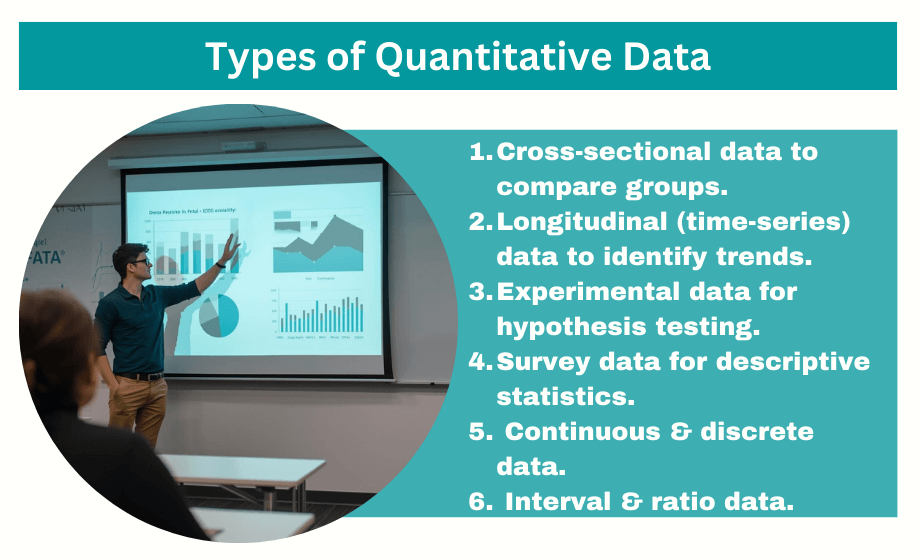
There are two main types of quantitative data that our experts analyze, which are discrete and continuous. Discrete data comprises countable values that cannot be decomposed into fractions or decimals. Alternatively, continuous data represents measurements that can be subdivided and assume a value within a range. In this section, we have discussed the common qualitative data analysis techniques that our skilled statisticians employ:
1. Descriptive Statistics
Descriptive statistics are techniques that are used to summarize the characteristics and distribution of a set of data values. Scholars utilize a graphical representation of data or compute a number to summarize a specific characteristic of a variable. Our experts provide the best descriptive analysis services by computing the measures of central tendency, frequency, dispersion, and variation. We also create excellent graphical displays that demonstrate the shapes of distribution, relationships between variables, and highlight any outliers. By employing descriptive statistical methods in academic research, scholars can identify patterns and trends, detect anomalies, and prepare data for further analysis.
2. Inferential Statistics
Inferential analysis methods allow investigators to make conclusions about a broad population based on a sample. Inferential statistics are classified into two main categories, which include estimation and hypothesis testing. When sample statistics are used to approximate population parameters using a single or a range of values, this is referred to as estimation.
Hypothesis testing involves formulating an assumption about the population in general based on information observed in a sample. Inferential statistics services clients can get when they hire a quantitative analysis expert from our company include i). t-tests, ii). chi-square tests, iii). ANOVA, iv). regression analysis, v). Mann-Whitney U test, and vi). Wilcoxon Signed-Rank test, among others.
3. Factor Analysis
Factor analysis allows scholars to simplify complex variables using statistical procedures to explore the underlying dimensions that explain the relationships between the items. Factor analysis is classified into two main categories, which are exploratory and confirmatory. While both exploratory and confirmatory factor analysis techniques model the observed covariance among variables through latent predictors, there is a significant difference between the two approaches.
Exploratory factor analysis is a technique that is utilized to identify the underlying relationships between a large number of observed variables by reducing them into fewer latent factors. Confirmatory factor analysis is a data analysis method that is used to evaluate the fit between observed data and a theoretically grounded model, specifying the causal relations between latent factors and their observed variables. At our company, we provide the best factor analysis services designed to simplify complex data in academic research.
4. Time Series Analysis
A time series is a sequence of data points that are usually measured at successive periods. In academic research, scholars can utilize time series analysis to understand the pattern of change over time or evaluate the effects of a planned or unplanned intervention. The time series analysis process encompasses three main steps, which include building, validating, and using a model to forecast events or impute missing values. Our skilled statisticians specialize in creating three classes of time-series models, which include (i) autoregressive (AR), (ii) integrated (I), and (iii) moving average (MA) models, based on client objectives.
5. Cluster Analysis
Cluster analysis is a statistical technique that is used to group similar data points based on their characteristics to represent patterns and underlying structures that would otherwise remain hidden. When similar data points are grouped using cluster analysis, scholars can simplify large datasets, identify relationships between variables, and detect outliers. In case you are looking for specialized help with any of the quantitative data analysis techniques, you can enlist the best services from our skilled statisticians for accurate results tailored to your academic research objectives. Connect with us today to find out how we can help.
Quantitative Data Analysis Tools Utilized in Academic Research
Quantitative data analysis tools are software systems that are used to examine numerical data to make meaningful conclusions. Using statistical tools enables scholars to simplify the quantitative data analysis process by avoiding repetitive mathematical tasks and producing accurate figures in their academic research. Some quantitative data analysis tools utilized by our expert statisticians include:
- Statistical Package for Social Sciences (SPSS).
- Python.
- Excel.
- Tableau.
- Minitab.
- R.
- SAS.
- STATA.
Reasons Why You Should Hire a Quantitative Analysis Expert From Us
Main reasons why we stand out as the best quantitative analysis company include:
- Expert statisticians. Our professionals are highly skilled in analyzing numerical data to draw meaningful conclusions, thereby ensuring accuracy in every study, whether a dissertation, research, or capstone project.
- Over 10 years of experience in offering professional quantitative analysis help. With 10+ years of experience and recognition as the best quantitative analysis company, we have a comprehensive understanding of the best practices and tools to employ based on client objectives. By enlisting our services, clients are assured of accurate results that make a significant contribution to their discipline.
- Fast turnaround time. We deliver data analysis tasks to clients on time without compromising on quality. Worried about meeting a deadline? Hire our quantitative analysis expert today and enjoy exceptional results delivered on time.
- Customized quantitative analysis services. Each quantitative study is unique, which is why our experts offer tailored analysis services that align with client goals. Some services clients can get from our statisticians include data cleaning, analysis, visualization, interpretation, and reporting.
Summary
Quantitative data analysis in academic research involves examining numerical data using statistical techniques to identify patterns and draw meaningful conclusions. Quantitative analysis techniques that can be employed in academic research include descriptive and inferential statistics, factor, cluster, and time series methods, among others. Software tools scholars can utilize to analyze quantitative data include SPSS, R, Python, STATA, SAS, Tableau, and Excel. Need to hire a quantitative analysis expert? Contact our professionals today for specialized help customized to your unique needs.