
Get Expert Help to Write a Psychology Dissertation

Doctoral students write psychology dissertations to portray their mastery in applying suitable research methods, critical thinking, and independent study. For postgraduate students seeking reliable help to write a psychology dissertation, our expert team provides comprehensive support from topic development to final submission. Our writers have over 10 years of experience writing psychology dissertations for PhD scholars successfully.
In this article, we have discussed the psychology dissertation format, which entails an abstract, introduction, literature review, methodology, and results. Also, we have discussed psychology dissertation topic ideas, such as clinical and counseling psychology, social and consumer psychology, and developmental and educational psychology.
What is a Psychology Dissertation?
A psychology dissertation is an original, comprehensive, and independent research project that students prepare to complete a doctoral program degree. A psychology dissertation demonstrates a student’s ability to conduct independent scholarly research. To write psychology dissertations that meet academic standards, students ought to adhere to the required formatting guidelines. A quality psychology dissertation entails identifying a unique research question and presenting results that validate the study while contributing new knowledge to the field of psychology.
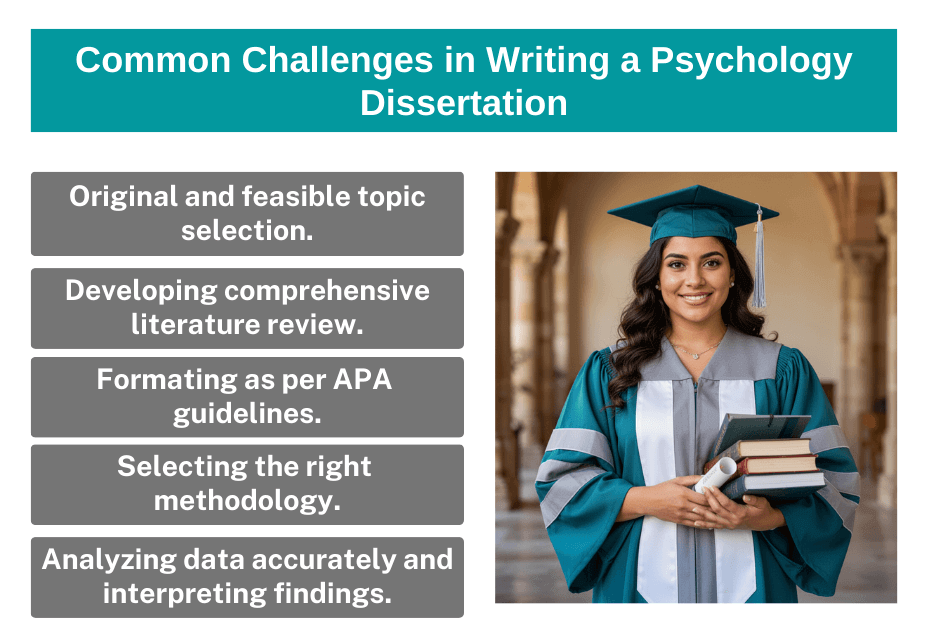
A Guide to Psychology Dissertation Format
Psychology dissertation structure is usually based on the APA 7th edition formatting. Below is the format of a psychology dissertation:
1. The Abstract
A psychology dissertation abstract is a brief and standalone summary that outlines the purpose, research methods, key results, and conclusion of the project. Additionally, a well-written abstract helps the reader quickly grasp the research’s relevance while ensuring proper indexing of a dissertation by academic databases. A psychology dissertation abstract is usually 200 to 300 words and is placed at the beginning of the project, right after the title page.
2. The Introduction
A well-structured introduction lays the foundation for a psychology dissertation by clearly defining the research topic, establishing its context, and articulating its purpose. The dissertation introduction section contains a definition of the research questions, justifies the study’s relevance, and outlines the research structure. In addition, the introduction chapter serves as a roadmap that explains the research’s ‘what’ and ‘why’. The introduction section of a psychology dissertation should be informative and clear to the reader.
3. The Literature Review Section
A psychology dissertation literature review contains a critical analysis of existing studies on a particular topic, forming the foundation for the research. The literature review entails the analysis, comparison, and evaluation of studies to outline contradictions, gaps, and trends in the field of study. Also, a literature review is pertinent in justifying the research’s relevance and establishing a theoretical framework.
4. Methodology Section
A psychology dissertation methodology provides the reader with an inclusive and justified plan of how the study will be conducted. To develop an exceptional dissertation methodology, scholars begin by explaining research designs, such as experimental, case studies, and correlational. Additionally, candidates outline data collection methods such as in-depth interviews, experiments, and observations. Also, students explain the analysis process and the software tools used in the analysis, such as SPSS, R, STATA, or Python. In addition, researchers usually outline the ethical considerations within the methodology section.
5. Results
The research findings are usually presented in the results section and organized based on the research questions or hypotheses. The findings are presented in tables, figures, or text for easier understanding. Also, quantitative findings should include descriptive statistics such as standard deviations and inferential statistics such as ANOVA, regression, correlation, factor analysis, and the p-value. Qualitative results are usually organized in themes and categories, and scholars should use participants’ quotes when reporting findings. Click here to place an order with us for help with a psychology dissertation.
6. Discussion and Conclusion
The discussion and conclusion sections contain an interpretation of the research findings and the implications of the study. In the discussion chapter, scholars not only report but also describe the results’ meaning, implications, and relevance in the field of study. The discussion entails an analysis of data that relates to the literature, while the conclusion briefly recaps key results to answer research questions.
7. References and Appendices
The references and appendices are the final and vital components of a dissertation after the conclusion. References should list every source quoted in the dissertation, while appendices should outline the supplementary materials too detailed to include in the main text. References are usually placed right after the conclusion, while appendices are located at the end of the document. Both references and appendices are formatted using APA 7th edition, whereby they start on new double-spaced pages, with clear, centered, and labeled headings.
Psychology Dissertation Topic Ideas
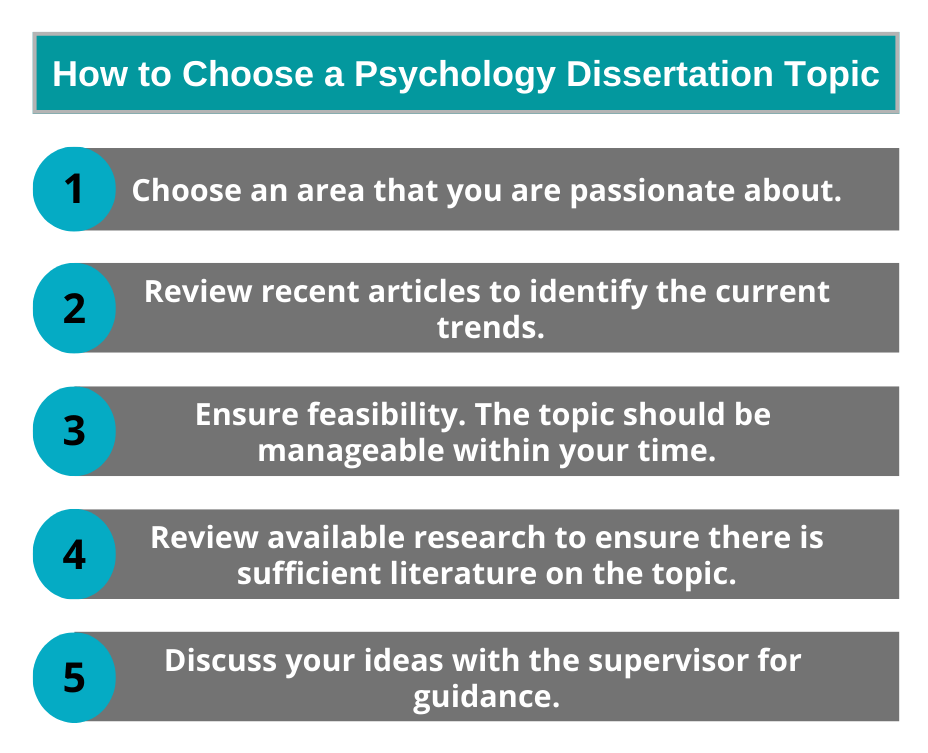
Our professional psychology dissertation writers help students choose the best topics, based on personal interest and passion, feasibility and scope, and research gap and originality. Below is a curated list of suitable psychology dissertation topic ideas.
1. Clinical and Counseling Psychology
Clinical and counseling psychology are closely related fields focusing on mental health. The fields involve the assessment, diagnosis, and treatment of behavioral, emotional, and mental disorders and have similar training, licensing, and roles in psychotherapy. However, clinical psychologists handle much more severe medical psychopathology, while counselors focus more on vocational and emotional adjustments. Examples of topics mostly discussed here include;
- Impact of Mindfulness-Based Interventions on Anxiety Reduction in University Students
- Role of Emotional Intelligence in Building Therapeutic Alliance in Counseling Settings
- Comparative Analysis of Online and In-Person Therapy Outcomes for Depression
- Influence of Trauma-Informed Counseling on PTSD Symptoms in Adolescents
- Quantitative Research on the Effectiveness of Group Counseling for Social Anxiety
2. Social and Consumer Psychology
Social and consumer psychology examines how cognitive procedures, social influences, and emotional factors drive purchasing choices and brand connections. By integrating social psychology with marketing, the topic explores how personality, social groups, and culture shape behaviors. Additionally, merging social psychology with advertising aids in the expansion of targeted, effective, and ethically conscious promotion policies. Some of the topic examples include;
- The Impact of Colour Psychology in Online Store Design on Impulse Buying
- Qualitative Research on Personal Identity and Brand Loyalty in Gen Z Consumers
- An Analysis of Product Scarcity Messaging and Consumer Urgency
- The Role of Nostalgia Marketing in Shaping Emotional Brand Attachment
- Systematic Review of Digital Advertising Fatigue and Consumer Avoidance
3. Developmental and Educational Psychology
Among the current psychology dissertation topic ideas is developmental and educational psychology. This topic is an interdisciplinary field, dealing with human learning, growth, and development from birth to adulthood, to optimize academic and developmental results. Developmental and educational psychology topics focus on emotional, cognitive, and social growth to create actual learning environments. Additionally, the topics help in the identification of learning challenges and supporting mental health. Common topic samples include;
- Could packaging nutritious foods in visually appealing ways encourage children to make healthier food choices?
- Do children who listen to music while studying perform better or worse on exams?
- What factors tend to influence the onset of depression in teens and young adults?
- How do peer relationships influence identity formation during adolescence and young adulthood?
- Do students who eat breakfast perform better in school than those who do not eat breakfast?
4. Cognitive and Forensic Psychology
Cognitive and forensic psychology topics unite to apply mental process study, perception, memory, and decision-making to legal contexts. Additionally, merging the topics enhances investigative accuracy and criminal justice results. Forensic psychologists utilize cognitive models to comprehend criminals’ behavior, improve eyewitness testimony, decrease biases, and evaluate competency. Suitable topic samples include;
- Quantitative Research on the Relationship between Psychopathy and Criminal Recidivism
- The Role of Eyewitness Confidence in Jury Decision-Making
- The Impact of Childhood Trauma on Criminal Behaviour among Incarcerated Youths
- Qualitative Research on the Experiences of Forensic Psychologists Working With Sex Offenders
- A Systematic Review of Risk Assessment Tools Used in Forensic Psychiatry
Signs a Student Needs to Seek Help to Write a Psychology Dissertation
We offer the best psychology dissertation writing services to manage overwhelming tasks, navigate complex methodologies, and ensure adherence to strict academic standards. Our experts utilize their proficiency to help students overcome nervousness and writer’s block, to prepare a professional dissertation within the set deadlines. A client should seek dissertation writing help when;
- A broad topic needs narrowing: Working with a broad PhD psychology dissertation topic may make research unmanageable within the constraints of word count, time, and resources. Our experts narrow down a broad topic to a specific and manageable research question.
- Facing writer’s block: Our experts assist students in overcoming writer’s block when preparing psychology dissertations, to avoid mental fatigue and procrastination. With our experts’ help, students can avoid physical, mental, and behavioral barriers such as poor planning or unrealistic expectations.
- Applying advanced research methods: Our psychology dissertation writers assist students in employing advanced methodologies, as the research approaches can be technically demanding and inherently complex. Additionally, we assist students in analyzing complex data using sophisticated software.
- Structuring arguments: Our experts structure arguments to convert raw ideas into persuasive and logical academic writing. Additionally, our writers make arguments more convincing and less tedious to address counterarguments effectively.
- Facing tight deadlines: If you are a student dealing with tight deadlines, our professionals can help to write a psychology dissertation on time. We have the expertise to prepare dissertations professionally, within tight deadlines, and still deliver quality.
Why Choose Our Psychology Dissertation Writing Services
Our writers provide rigorous methodological assistance and thorough editing to eradicate errors for a psychology dissertation that meets academic and professional standards. Here are the key reasons to choose our reliable writing services;
- Expert psychology writers: Our professionals hold advanced degrees with know-how in counseling, clinical, and behavioral psychology. Our writers prepare original, high-quality, and academically compliant dissertations.
- Tailored writing support: Our PhD psychology dissertation writers provide tailored support with topic selection, project structure, research methods, and literature synthesis. We offer customized support to ensure academic integrity, adherence to precise institutional requirements, and originality.
- High-quality and original work: We offer professional psychology dissertation writing services by identifying a specific research gap and conducting a comprehensive literature review. Additionally, we formulate unique research questions while applying transparent and rigorous methodologies to generate new insights.
- Time efficiency and reliability: Among the pillars of a successful psychology dissertation are time efficiency and reliability. Our experts are reliable and time-conscious; therefore, they complete dissertations within the set deadlines while maintaining high academic standards.
- Comprehensive assistance: Our professionals assist PhD students through complex research, writing, and analytical tasks for academic success. We offer reliable writing assistance to improve academic quality and provide ready-to-submit psychology dissertations.
- Privacy policies: To ensure clients’ security, our experts observe confidentiality, non-disclosure of personal and academic information, and safe payment methods.
Summary
Students write professional psychology dissertations as a requirement to attain their doctoral degree. By writing quality psychology dissertations, students contribute unique knowledge to the field for academic success and career development. Our writers are experts in developing outstanding psychology dissertations from the introduction to the discussion and conclusion sections. Our experts are available 24/7 and ready to meet clients’ writing needs with professionalism. If you need reliable psychology dissertation writing services, feel free to contact us or join our live chat to talk to our friendly customer service agents.