
Primary Vs. Secondary Data Collection Methods for Dissertation Research

One of the most challenging stages of dissertation writing is data collection, and getting it right, to get credible findings that answer research questions. For scholars navigating the dissertation journey, understanding the differences between primary and secondary data collection methods is essential for determining the most suitable technique to employ based on study objectives. If you are a PhD student looking for help with primary data dissertation, our experts provide assistance with collecting and analyzing original data to accurately address scholars’ research questions.
By hiring our experts, clients get professional assistance with selecting sampling techniques, data collection tools, and methods that align with the goals of their research. Getting services from our experts enables clients to implement reliable and ethical data collection techniques for their doctoral research. This article contains an outline of some of the key comparisons between primary and secondary data collection techniques, such as sources, reliability, and time.
Understanding Data Collection in Dissertation Research
Data collection is the process of gathering data to gain useful insights into the research topic. The quality of the data collected directly influences the validity and reliability of the research findings. By collecting data, scholars are able to gain valid information on the research problem that can be analyzed and transformed into useful insights that can be utilized to solve issues, answer questions, and achieve desired objectives.
Types of Data Collection Methods for the Dissertation
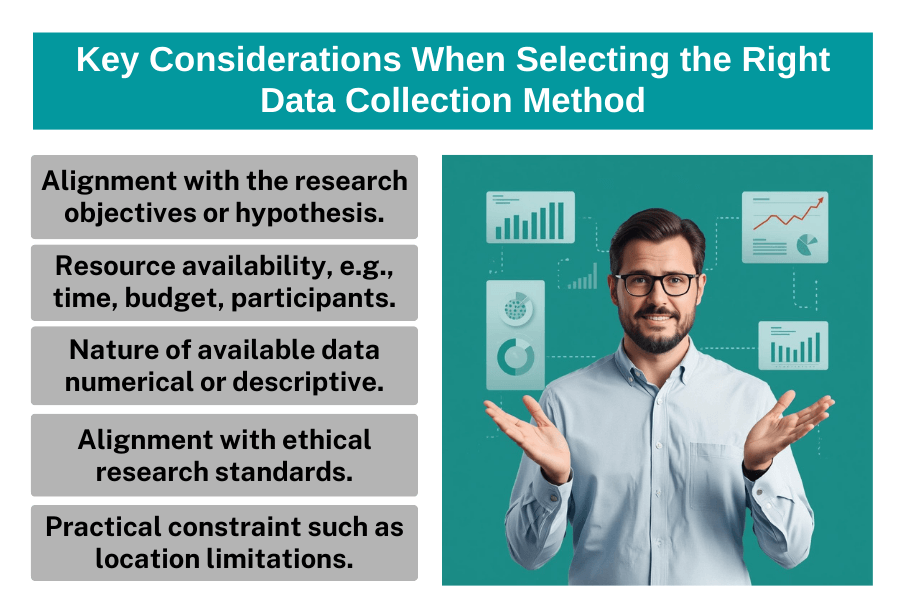
When developing a research design for the dissertation, a major methodological choice scholars should make is whether to employ primary or secondary data collection techniques. Each method has distinct advantages and disadvantages, so students writing their dissertations should select the most suitable option that aligns with their research goals. In this section, we have discussed the two main types of data collection for the dissertation.
1. Primary Data Collection
Primary data collection is the process of gathering firsthand information directly from the source to answer specific research questions. Scholars usually employ primary data collection techniques when they require specific and current data, tailored to their research objectives. Some primary dissertation data sources that PhD students can apply include (i) surveys, (ii) questionnaires, (iii) interviews, (iv) observations, and (v) focus groups. Primary data collection techniques typically have the advantages of accurate, original, and reliable data that is gathered directly from the respondents.
2. Secondary Data Collection
Secondary data collection involves gathering pre-existing information to answer new research questions for which the data collected was not originally intended. Circumstances under which scholars would utilize secondary data collection methods for the dissertation include:
(i). For studies involving sensitive topics or populations.
(ii). When there are limited resources.
(iii). When examining patterns and trends over a long period of time.
(iv). If the target population is hard to reach.
(v). If the study involves a large population, the research questions are generally broad.
(vi) When supplementing primary data in research.
By hiring our experts for help with secondary data dissertation, scholars save the time, money, and resources that would have been utilized to conduct original research.
Key Differences Between Primary and Secondary Data Collection Methods
Below are the main differences between primary and secondary methods of data collection for the dissertation:
1. Data Collection Sources
Primary data is information that is collected firsthand by the scholar to understand and solve a specific research problem. PhD students writing their dissertations can apply various methods of primary data collection, such as surveys, questionnaires, interviews, focus groups, observation, and case studies, depending on their study objectives. In case you are looking for professional help with primary data dissertation, we specialize in developing feasible data collection plans, selecting the most suitable sample size, analyzing, and interpreting data to make conclusions.
Secondary data is already available and collected by another investigator, for a purpose other than the scholar’s study, and has been made available for reuse. Common sources of secondary data that PhD students can employ include published printed sources, books, journals, periodicals, magazines, and government records, among others. When considering primary data vs secondary data, scholars should evaluate key factors such as the research objectives, budget constraints, time limitations, and the availability of information. If you need help with selecting the most appropriate data collection technique to apply, you can hire our expert dissertation writers today.
2. Time for Collection
The process of primary data collection comprises several steps that require comprehensive planning and coordination among participants. Scholars are required to select a sampling technique, plan the study, ensure ethics, and collect accurate data, which takes a significant amount of time to complete. Generally, primary data takes a longer time to collect and analyze compared to secondary data that is readily available.
Secondary data is more time-efficient as PhD scholars access readily available information instead of collecting new data. By utilizing pre-existing data, students writing dissertations avoid the time-consuming process of sample selection and recruiting participants, thereby completing their studies in a timely manner. However, while secondary data collection is more time-saving, it requires strong evaluation and analytical expertise for accurate results, so most students opt to get professional help with secondary data dissertation.
3. Reliability
Primary data is generally considered more reliable than secondary data because the researcher has full control over how the information was collected, cleaned, and evaluated for quality. Primary data is also more suitable for a PhD dissertation research, as data is collected for a specific purpose. Alternatively, the reliability of secondary data depends on the source and the techniques used to collect information. There is little to no control over how the data was generated, possible modification of data by the investigator, and potential poor documentation that could make the data unreliable.
4. Scope
In primary data collection, scholars gather information that is focused on a specific research question or hypothesis. Additionally, primary data collection is limited by a smaller sample size, high costs, and significant time investments, therefore contributing to a narrower scope. In contrast, the scope of pre-existing information is broader, as secondary data collection involves the combination of information collected by professionals, longer periods, and diverse geographical locations that would be impossible for a PhD scholar to gather firsthand.
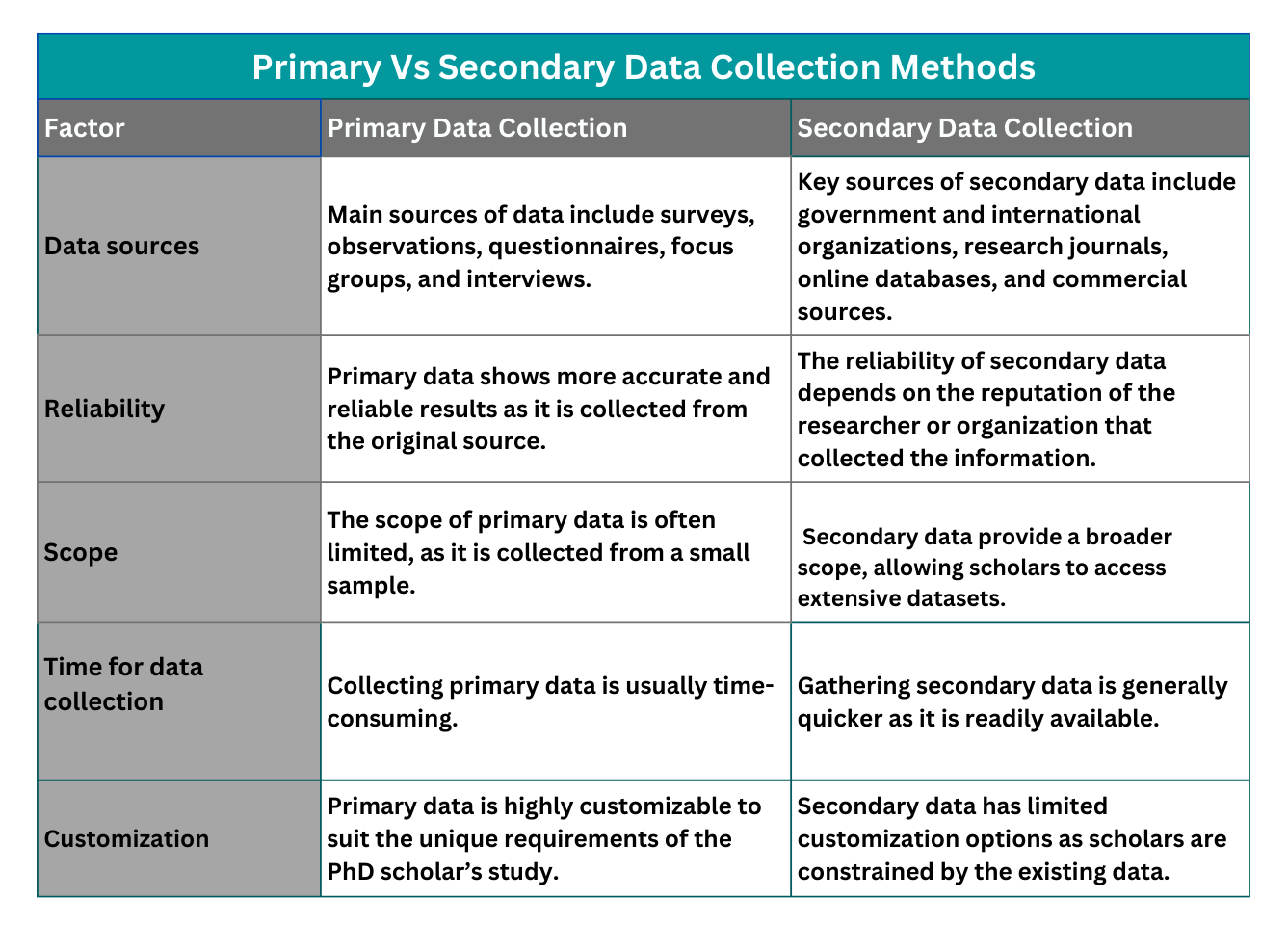
Comparison Chart of Primary and Secondary Data Collection Methods
The table below demonstrates the key factors that differentiate primary and secondary methods of data collection:
Get Professional Help with Secondary Data Dissertation From Our Experts
Ethical and logistical problems in a research setting can limit the possibilities of primary data collection for the dissertation. Therefore, scholars opt to collect and analyze pre-existing data to answer research questions and make valid conclusions. At our company, we specialize in offering professional help with secondary data dissertation to enable PhD scholars to answer their research questions or examine an alternative perspective of an existing study. We utilize credible databases, peer-reviewed journal articles, repositories, and government reports to ensure maximum accuracy.
Our dissertation experts follow a systematic process for secondary data collection. First, we locate authentic data sources that are useful to the clients’ research problem. Second, our experts evaluate how well the secondary data meets the quality requirements of current research by considering criteria such as i). the research design used, ii). accuracy, iii). objectivity, iv). nature of data, v). dependability. Third, we assess the credibility of the data by establishing the credentials of the original investigators, determining the consistency of the data with other sources, and determining whether the data has been used in any credible research. Fourth, we extract the most relevant data and organize the information systematically using techniques such as coding matrices and citation management systems, depending on the scholar’s research objectives.
Why Choose Us for Expert Help with Primary Data Dissertation?
Main reasons why PhD scholars should hire our experts for help with primary data dissertation include:
- Expert team. Our dissertation experts are highly skilled in collecting primary and secondary data for PhD research and ensuring the best outcomes. With 10+ years of experience in helping scholars collect data and develop feasible research designs that align with the objectives of their studies.
- Use of advanced research methodology We use data collection tools such as questionnaires, ratings, attitude scales, tests, and surveys to gather high-quality data and contribute to knowledge advancement in the clients’ field of research.
- Guaranteed punctual delivery. Our experts ensure that each order is completed within the client’s preferred schedule. Even for scholars with tight deadlines, we work within the specified time frame and deliver quality results.
- Availability around the clock. We offer help with primary or secondary data for dissertations 24/7, enabling clients to reach out to us at any time for inquiries, order updates, and requests for revisions.
Summary
Primary data collection involves gathering information from an original source that directly answers the research question. To collect primary data, scholars can utilize various sources, including surveys, experiments, interviews, case studies, and observation, among others. Secondary data collection is gathering existing data to answer new research questions for which the information gathered was not originally intended. Secondary data collection techniques are most suitable for studies involving sensitive populations where gathering information may be difficult. In case you are looking for help with primary or secondary data for the dissertation, you are in the right place. Contact us today for specialized help with primary data dissertation and enjoy subject-matter expertise, on-time delivery, and exceptional customer support. You can also join our live chat for a one-on-one conversation with our friendly customer service agents.